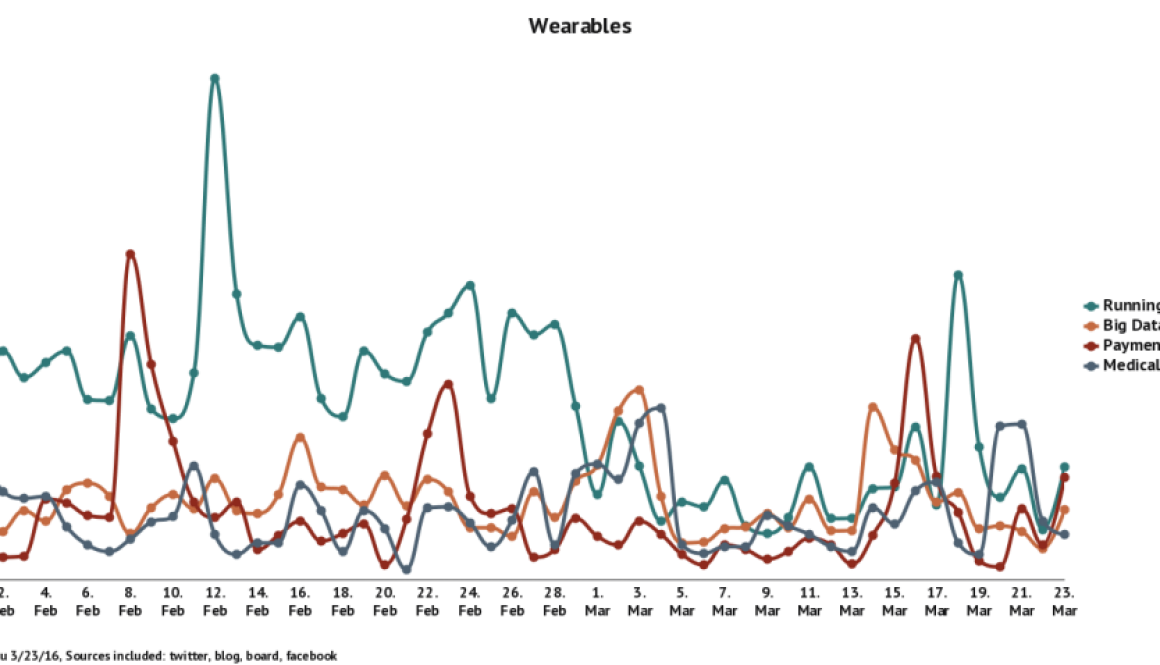
What’s the next big thing in Wearables? Here at Argus Insights, we track social conversation across entire markets to discover what’s top of mind. Recently, there has been a lot of discussion about running, jogging, and big data in Wearables discussion. News of a developing energy harvesting shoe insole recently sparked interest in run tracking to help drive up mindshare about using wearables while running and jogging. Use of wearables at the SuperBowl got people talking about Big Data and all the possibilities that come with the large amount of data collected from wearable devices.
Chart of the Day: Self charging insoles and Super Bowl Big Data drive Wearables social discussion
For fresh insights every week, sign up for our free weekly newsletters for the Smartphone, Smart Home, Wearables, and SDN/NFV Markets.
March 23, 2016 Where’s the Kaboom? In an unprecedented global smartphone downturn, plus a saturated marketplace of tablets, laptops and desktops, and declining Year-Over-Year stock price, there was supposed to be a market shattering launch from Apple this week. Perhaps a smartwatch re-launch! Perhaps a Homekit announcement! But instead we got a neat new… nylon wristband!?
As designers, industry experts, and consumers ourselves, the Argus Insights team has been keeping tabs on Apple since the original iPhone launch.
During Apple’s latest Keynote address we thoroughly enjoyed the forty second video of forty years of Apple history. We have watched consumers fall in love with the company’s products (via our extensive collection of consumer data and analytics tools) as iPhone became a proxy for “smartphone” and iPad became interchangeable with “tablet”. But now in the era of the Smart Home and Virtual Reality… Apple is on the sidelines.
In fact, does the Smart Home even exist if Apple’s not in it? Smart Home consumers have been waiting for details about Homekit since it was first hinted at the Worldwide Developer Conference in 2014. Ever since, consumer reviews and social media posts have been pleading with companies for Homekit compatibility. Sure, you can buy “Homekit Compatible” devices today that contain a piece of silicon, allowing them to be controlled through Siri, but Homekit still isn’t really a thing.
Consumers are pretty distraught at the jumbled state of the market. A comment from an Ecobee thermostat consumer sums up the mix of anticipation and confusion that surrounds the current state of Homekit: “Screw you ecobee for not providing an upgrade path to homekit I feel abandoned.” Smart Home consumers are being forced to move on without a concrete offering from Apple, but they feel “abandoned” due to lack of Apple compatibility.
Outside of some rather progressive environmental policies, and incremental new products and services, there were conspicuous absences in this week’s keynote. Some consumers will be happy with a smaller iPhone (actually, some people just have smaller hands. We saw complaints about handset size in the iPhone 6 Plus data last year). However, we are still waiting to see if, and (more importantly) how Apple will bring their signature innovation juggernaut to bear on the Smart Home market. Until then, we will continue to analyze the current state of the market and how Apple’s absence is affecting consumer behavior.
For more info, or to parse the signal from a noisy marketplace, Argus Insights developed Smart Home Fit Kits with the most up-to-date competitive intelligence and market trend data on the Smart Home marketplace. www.argusinsights.com
The era of Big Data is squarely upon us, and it holds the potential to be the most transformative force in business since calculators replaced slide-rules. However, the potential that comes with access to droves of data will only be realized by individuals with courage. I have encountered only a handful of companies, teams and individuals with courage in my career. Here’s why courage is rare:
Courage is challenging the established models and ways of thinking. Courage is fighting for metrics that matter to the success of the enterprise. Courage is listening to the evidence careening back from the market at the speed of customers’ buying decisions. Courage is action with forethought.
It was not courage that led smartphone manufacturers to ignore the early success of the iPhone, or the marketing team of a global retailer to ignore the hijacking of their brand during Black Friday- it was hubris. Hubris coupled with a strong dose of fear.
Executives can be bogged down by hubris-or fear of change, especially when their internal research demonstrates how much current customers love their brands and products. If everything you have says you’re great, stay the course. Don’t waver from the status quo because anything different is terrifying.
Advancements in the way we collect and interpret data allow for a broader view of the market than ever before, but many companies today are confusing quantity with quality, leaving trillions of dollars of untapped value on the field of play.
The plain truth is Big Data without Big Action is a Big Waste.
Companies have the unprecedented ability not just to shout about their brand, but to listen to the heartbeat of opportunity thumping strongly within every consumer in the markets they are striving so hard to win. Big Data allows companies to listen to what makes user’s hearts strum with excitement, palpitate with fear, and drum their owners into a decision to buy from you over the competition.
Right now, most of marketing technology is being used to by companies to turn Big Data into Big Noise. This results in loud brands that force their message into to the conversation of the commons. Re-marketing campaigns follow users with ads months after they’ve already made a purchase. Attribution engines strive to be the last ad clicked before ‘buy,’ but increasingly force customers to say ‘bye’ to those brands out of sheer annoyance.
Do you have the courage to listen and learn? Are you seeking the evidence needed to move the market? Are you ready to drive dialogue instead of participate in parallel monologues with your competitors?
If that’s you, we need to talk. We craft tools for heroes like you. Need evidence to evolve your enterprise? Check. Metrics to move your market? Check. Tools to sharpen the talons of your team? Check. Support that sustains your success? Double check.
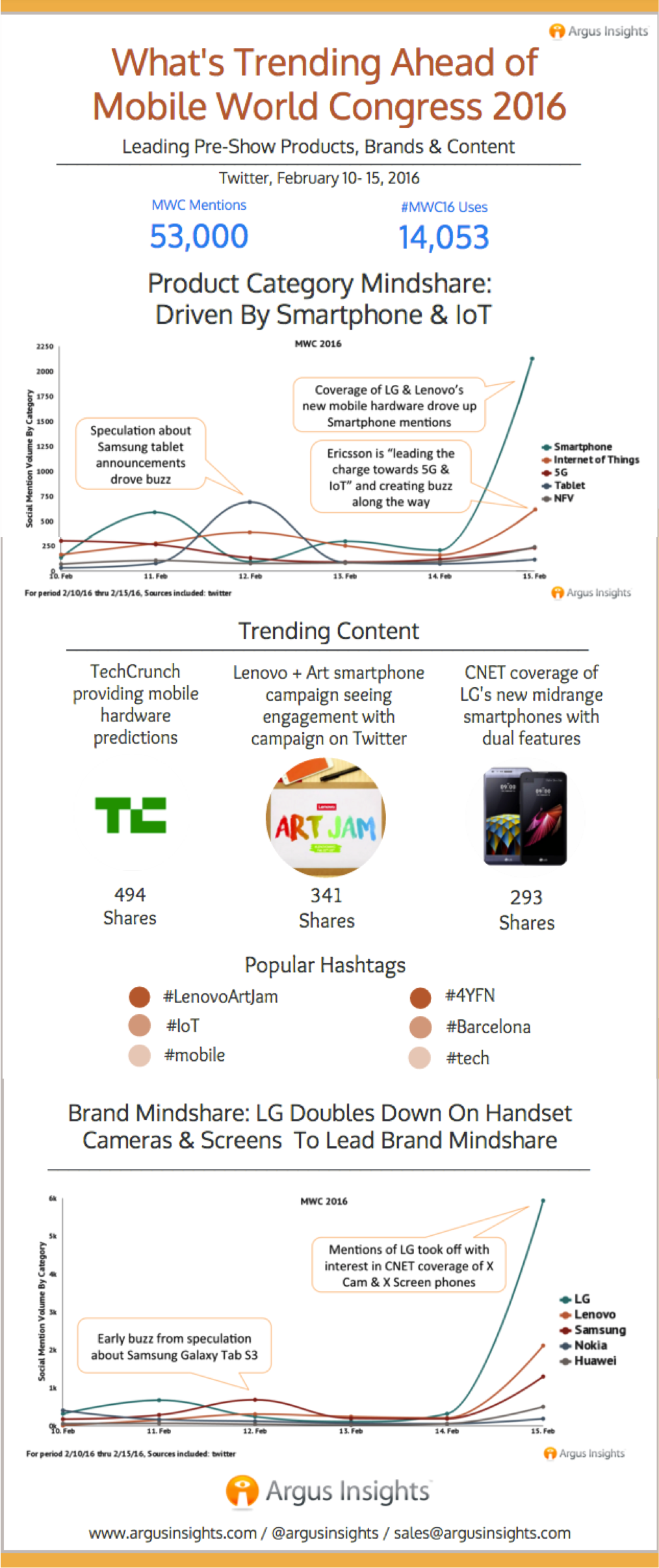
Argus Insights will continue to monitor social Mobile World Congress discussion throughout the show, keep an eye on this blog for more updates. Please contact us if you are interested in information about the performance for a specific brand, product, or market throughout the show.
In the fall of 2015, just prior to the launch of the iPhone 6S and 6S plus, I wrote a post describing a hypothesis that this might be the last quarter of Apple driving significant growth in the smartphone market, as t he number of consumers without a smartphone shrinks at a faster rate than the number of consumers without an iPhone. Apple shocked the world when rumors were coming from across the ocean, he land where all things Apple are made, that they were being asked to scale back production by at least 30%. We were not shocked at Argus Insights. Not only have we been seeing the decline in Apple in the US for some time, we have also previously reported on the marginal demand increase of the 2015 iPhone launches.
Globally we are seeing a slowdown in iPhone demand. Of the regions we track, only China saw growth in iPhone demand where the demand for older handsets, 6 and 6 plus, outstripped the demand for new handsets on by almost 80%. This suggests that Chinese consumers prefer the lower priced handsets of the prior generation over the new features available on the 6S and the 6S plus.
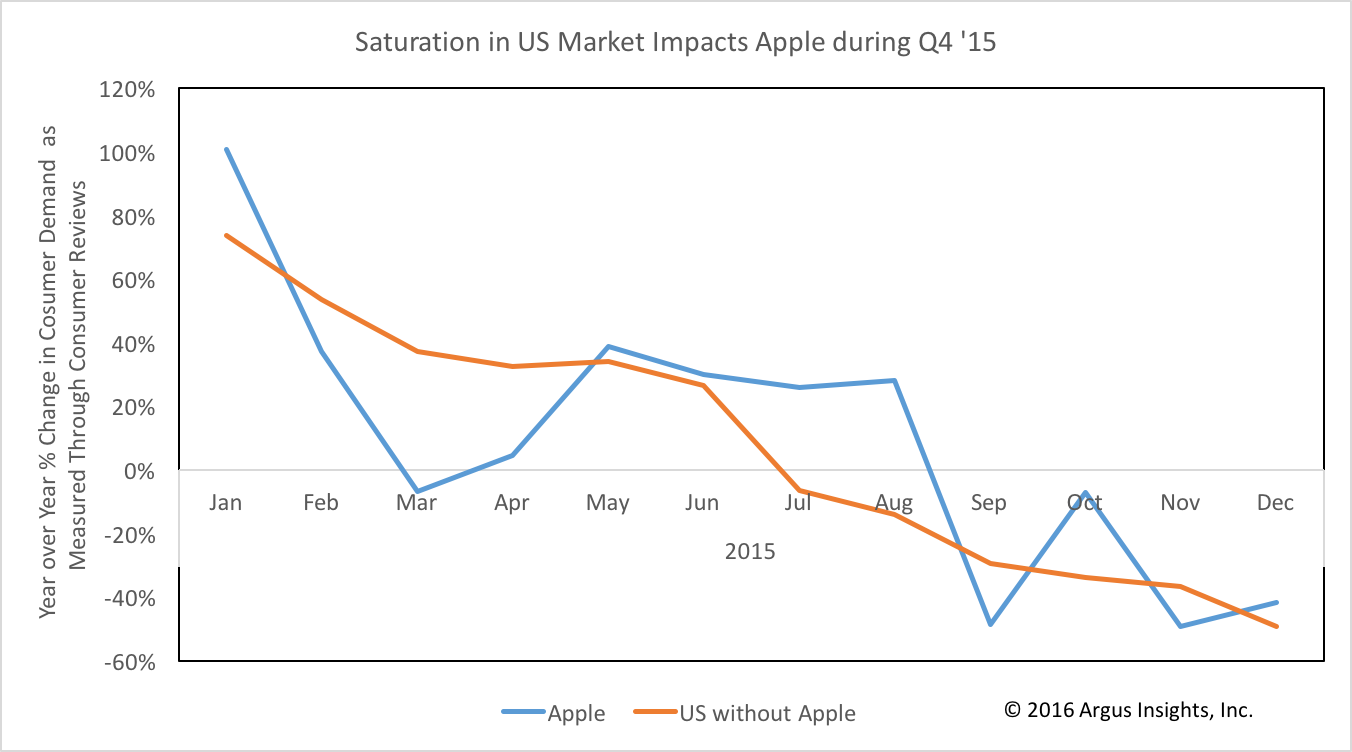
Demand fell the most in the US market. After the initial boost around the release date of the 6S and the 6S plus in late September, demand almost disappeared. Then the holiday promotions started rolling in, not only for iPhone but also Apple Watch and iPads. Discounts were applied on the actual price, not the typical retailer trick of offering a gift card, to comply with Apple’s “you can’t compete with the Apple Store pricing” mantra for retailers; meaning that Apple endorsed what started off as “door-busters” and evolved into recurring discounts similar to what Samsung has done in recent years to boost demand in the face of competition from Apple.
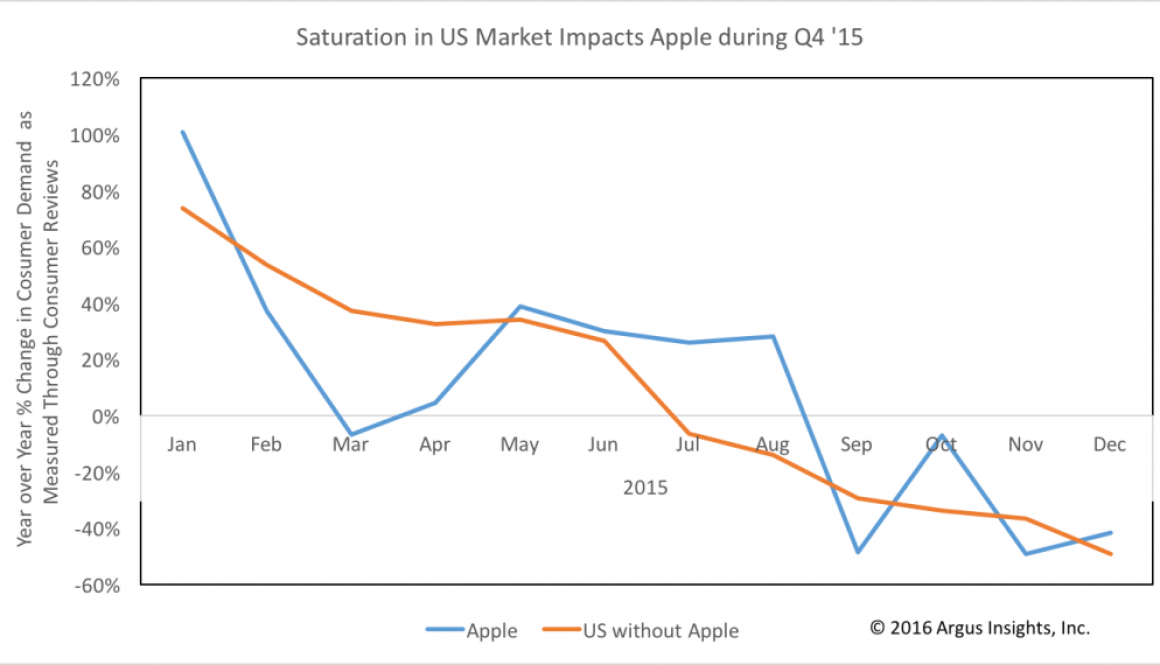
Major US carriers were hit especially hard, since fierce competition to grab consumers upgrading to the larger screen iPhone 6 and 6 plus in 2014 bucked many consumers out of their normal two-year upgrade cycles. Even Best Buy, the iconic outlet of tech you can still touch and buy, saw demand trend flat for iPhones in Q4. Part of this is due, as you can see in the graph above, to the fact that overall demand in the US market is falling year over year as consumers are keeping handsets longer. This trend is due to both lack of reason and lack of resources to upgrade. Apple has been riding the waves of adoption but is beginning to fall off.
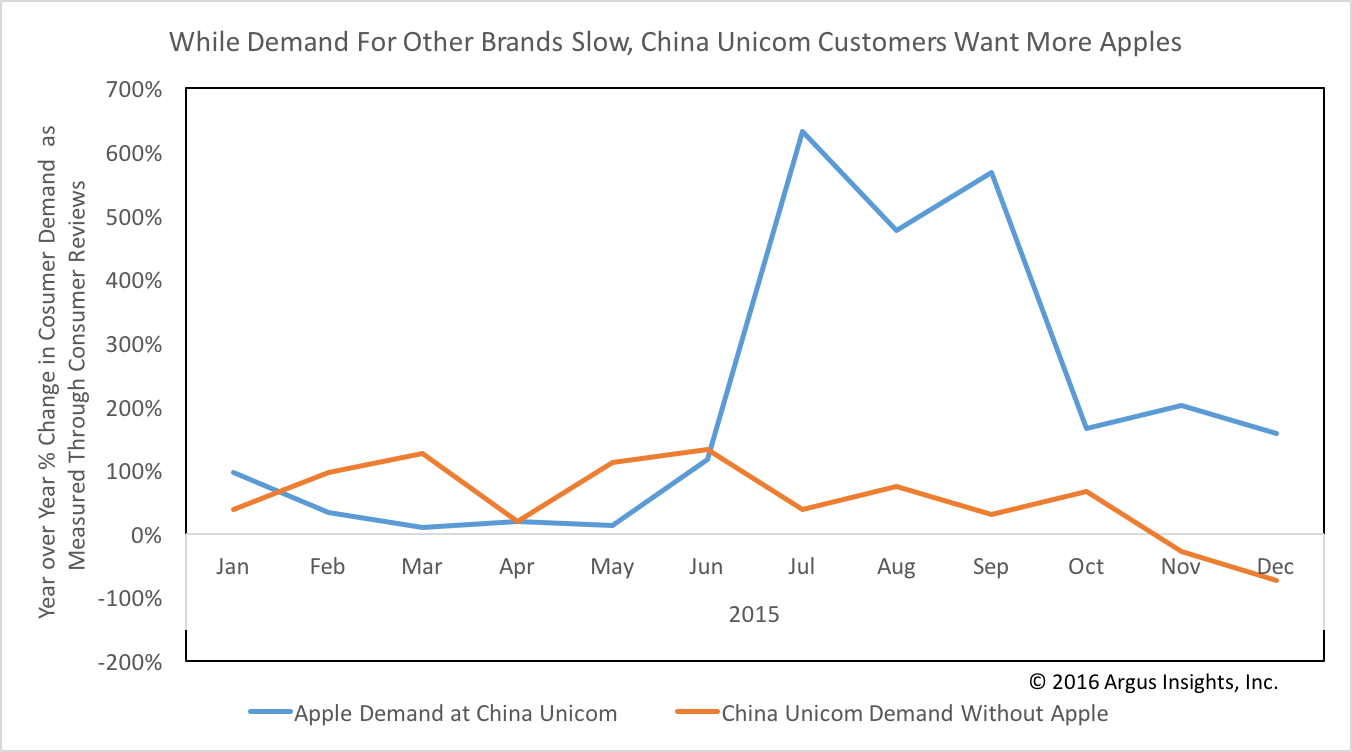
China is the one potential bright spot in Apple’s slowing plod toward global domination. Our data coming from China Unicom, a proxy for Chinese consumers, showed that Apple continued to show year over year demand increases, even as demand for other brands slackened. While the demand over the summer for large screen 6 and 6 plus handsets drove most of the Unicom demand, there is evidence that Chinese consumers retreated from the smaller screened 5S and 5C models given the assortment of attractive alternatives from Xiaomi and Huawei. In moving to mostly large screen devices, Apple has all but squeezed out Xiaomi from the minds of China Unicom consumers. As such, any weakness in demand in the US markets in Q4 will be offset by significant demand from China. Demand driven as much for the now cheaper 6 and 6 plus as for the new S model handsets. Given the poor response to the 5C in China, we have our doubts that a 6C will fare any better with consumers in China and India.
Smartphone demand is slowing in all markets at a huge cost to Apple’s sustained growth in actual handset sales. Though global smartphone demand is slackening, the number of iPhone users grows continuets to grow, albeit rather slowly. The revenue from each existing Apple user will sustain the company’s operations for years to come.
Interested in even more data? Check out all the insights we have to offer about the Smart Home, Wearables, Smartphone, and several other markets. To chat with us personally about consumer perception in your market, schedule a free market fit assessment.