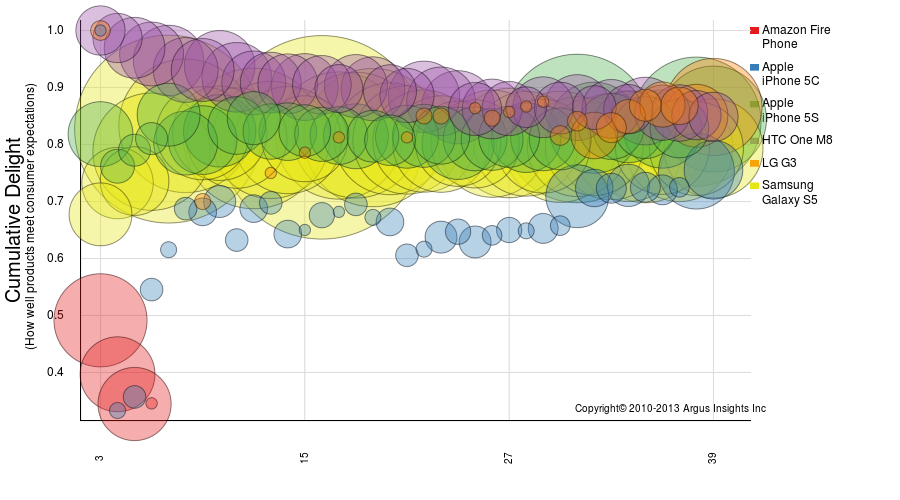
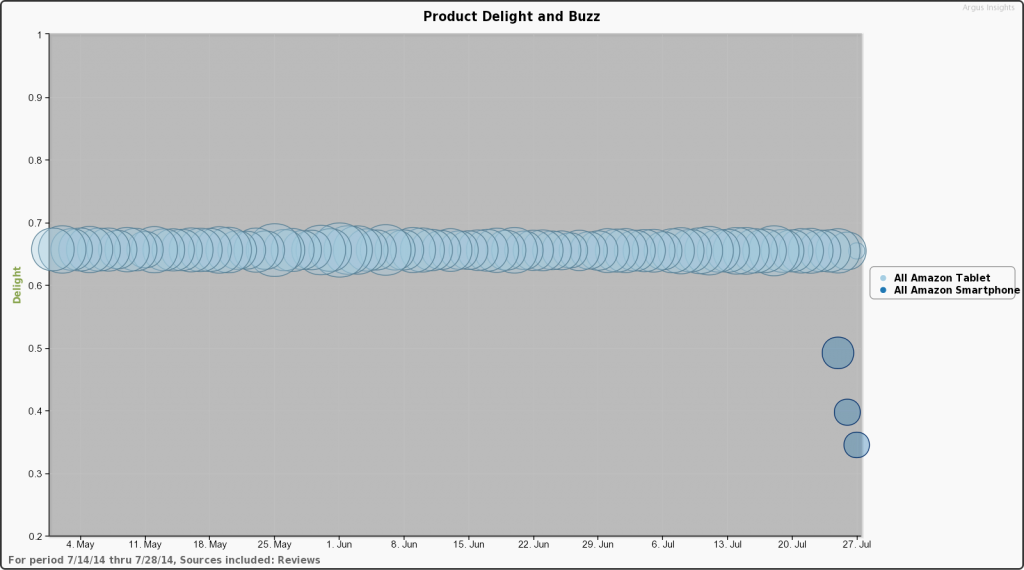
Amazon’s Fire Phone lit into the hands of users late last week. As typical Amazon customers, early Fire users were not shy about sharing their views with others. But unlike Kindle Fire Tablet customers, Fire Phone users are not ablaze with desire for more of their new handsets. Bad fire puns aside, new users flamed Amazon with some of the lowest delight scores we’ve seen for a new phone launch this year.
Amazon Fire Phone suffers a poor launch compared to other recent flagship smartphone launches.
In fact, when compared to the Kindle Fire Tablets, this is the lowest delight scores we’ve seen for Amazon.
Kindle Fire Tablets have a strong place in the hearts and minds of consumers but the Fire Phone flickers in comparison.
What gives? Is the Fire Phone doomed to spark interest in smartphone consumers? The early data is not very promising. As we get more insights as to the why, of course we’ll share them here.
I don’t know about you but my inbox has been awash with ads from Apple and others with first class tickets for a guilt trip if I don’t get my mom (or my wife) an iPaxly Fire tablet or Next S5 Dash 8 smartphone for Mother’s Day next weekend. The gadget blogs have all been discussing what is the best phablet to get for the mom that desperately needs more megapixels in their live and delivers more cores than Octomom! But this is for Mom. Do we want to trust the guidance for a gift to the person that brought us into this world to the manufacturers who seek to siphon off more of mom’s monthly income in the name of ARPU so that you’ll have to support her later in life? No! Do we listen intently to the same geeks that told us the iPhone was a toy and that vinyl was dead? No! We listen to the one that soothed our sore throats with love and honey, that kissed our skinned knees, that ensured us there are plenty of fish in the sea if we were patient. Mom, or in the case of Argus Insights, other moms.
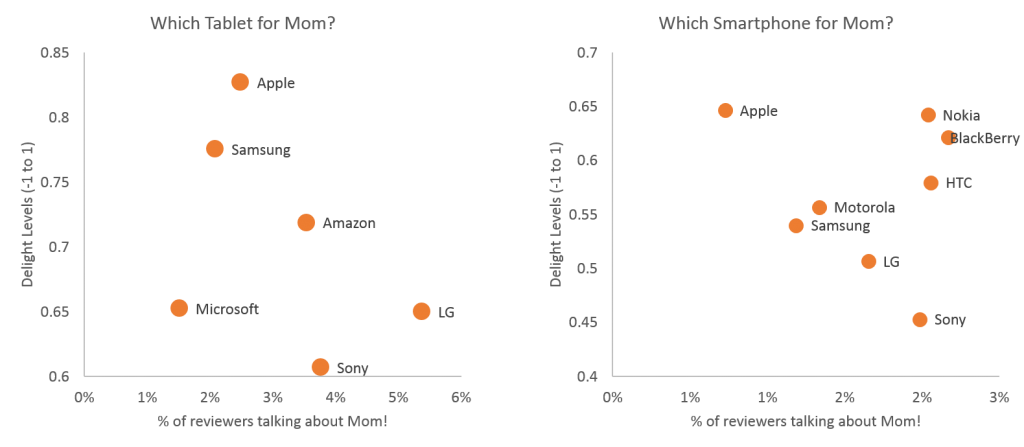
We culled through the millions of mentions by tablet and smartphone owners to see for those that discussed mom, and determine which brands delivered an experience worthy of our maternal gratitude.
Within tablets there is little surprise that Apple comes out on top. What is surprising is that more iPad owners aren’t chatting about the awesome gift they got mom. Amazon hits the sweet spot for the balance between price and delight while, juggernaut Samsung lags just behind Apple. Across the board, those reviews that mention Mom were higher rated than the rest of the population, bolstering the notion that Mother Knows Best.
Smartphones tell a different story though with the same beginning with Apple still leading the pack, just barely but with the lowest mom mentions of all the brands. Moms tell us that they like Nokia Lumia handsets just as much as iPhones (Mom always did like a bargain). Oddly Samsung is beat out by Nokia, HTC, even BlackBerry, whose recent push on Enterprise Mobility might need to shift to Enterprise Moms instead!
While this has all been a bit tongue in cheek (because Mom taught me not to stick out my tongue), the results are based on actual consumers discussions of what tablets and smartphones they love. The same data we used to beat Wall Street on Apple last week is being used to help you think about what to get Mom this year. So do Mom a favor, get something that will make life easier rather than forcing more gigabytes down her proverbial throat the way she forced you to consumer castor oil as a child.
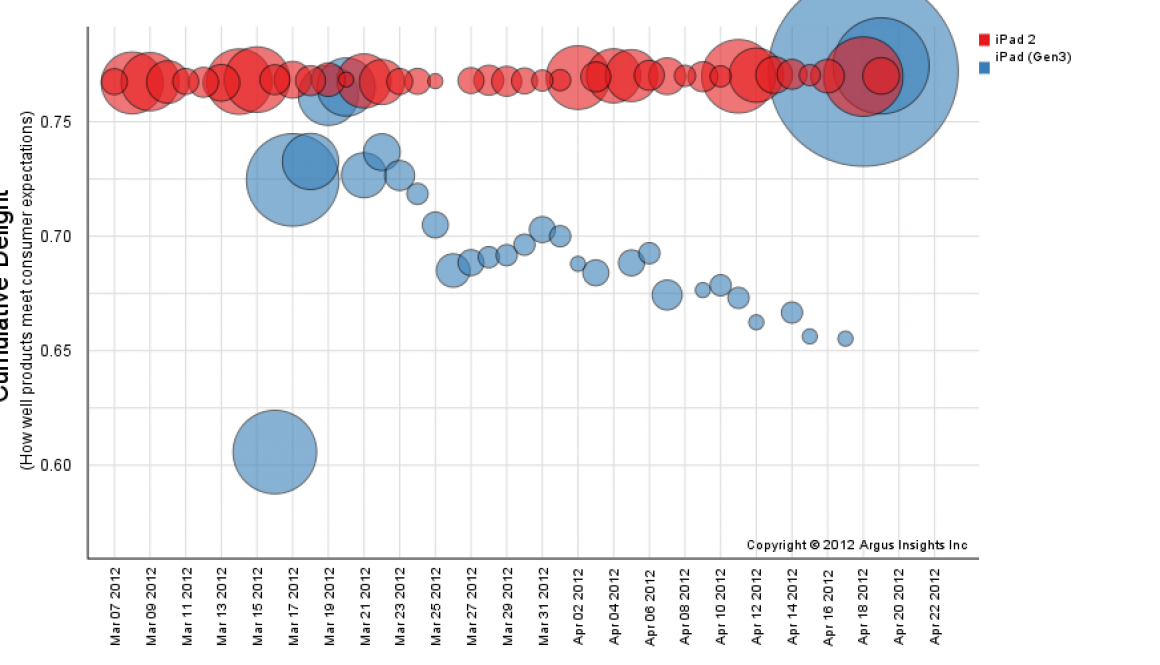
You know we’ve been sharing that the new iPad has proved to be a more compelling reason for consumers to buy an iPad 2 than the new iPad. Then the improbable happened. The iPad 3 recovered. It did more than recover, it jumped to the top of the charts. It’s like the whole family answered the call to review Aunt Bertha’s steamy romance model on Amazon when sales were flagging. Check out the graph below to see what we’re talking about.
The new iPad has a miraculous recovery in the hearts of consumers after tax day.
What happened? Was this the result of post Tax Day ex
uberance? “Now that I’m getting a tax refund, I’m buying a new iPad!” The new iPad jumped ahead of the iPad 2 after a rapid decline in delight, something unheard of for an Apple product. In fact, the new iPad is considered to be the most delightful tablet on the market today, barring any new releases in the coming weeks as you can see in the sparklines below.
Summary of top tablets in North America. The new iPad shot to the top after languishing in the middle for weeks after launch.
If you want to know why this drastic shift took place, give us a shout at Argus Insights. We’ll be releasing a report on all the sordid details of the new iPad’s market response in the coming weeks that will include our own forecast as to the future success of the new iPad.
Today Apple announces the next iPhone, wait, iPhones. Off their traditional one year release cycle but bouyed by the rapid adoption/defection to Verizon by iPhone 4 customers, Apple is expanding their game in the US Market. Question is, will Sprint achieve the gains expected by iPhone exclusivity over the coming months. Our feeling at Argus Insights is yes!
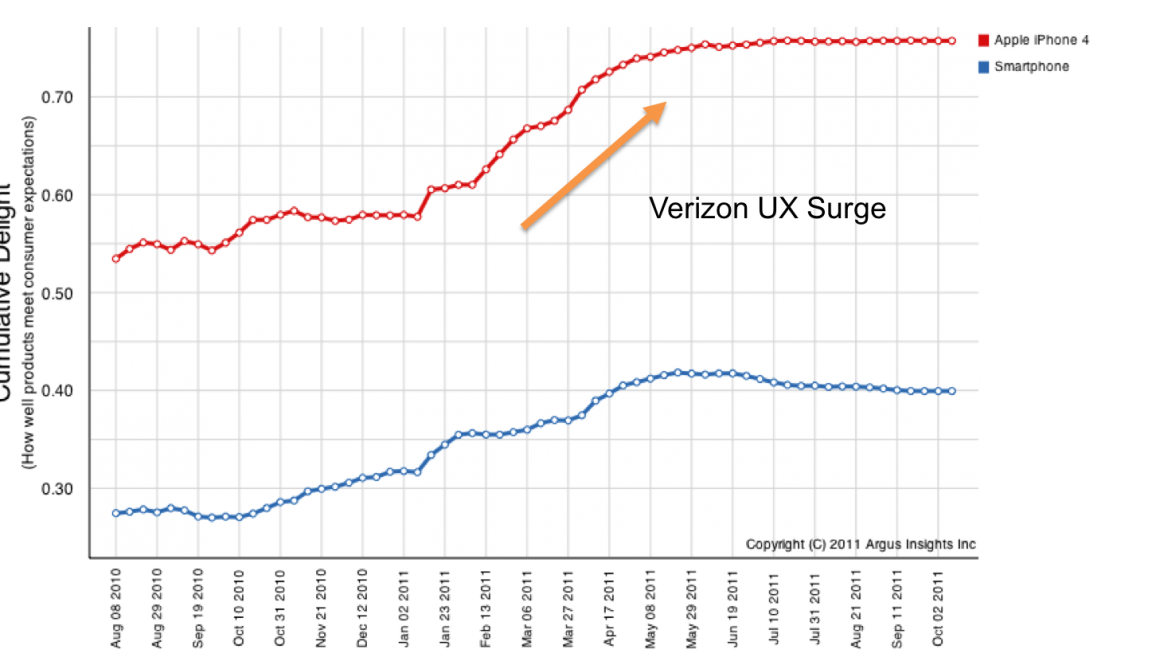
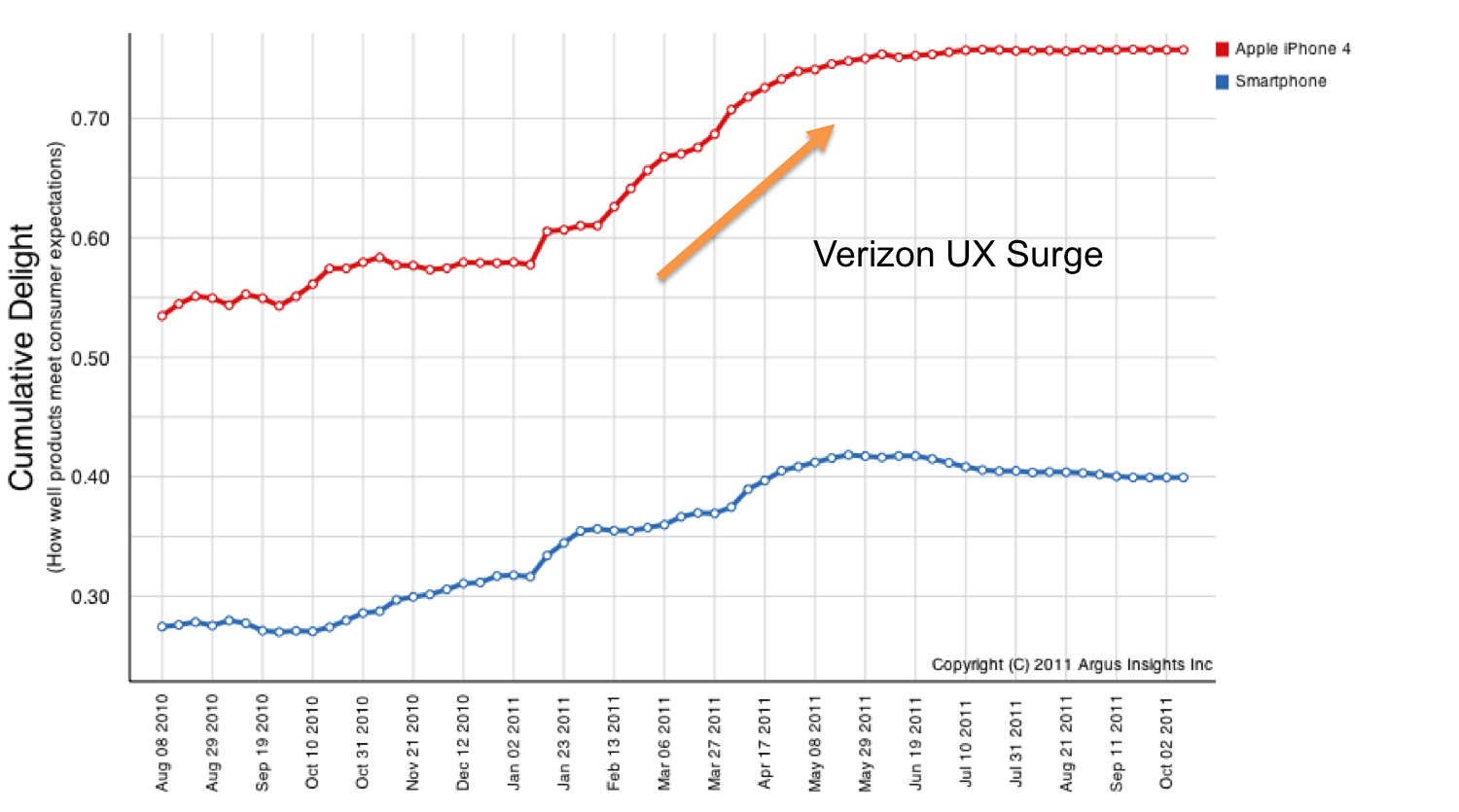
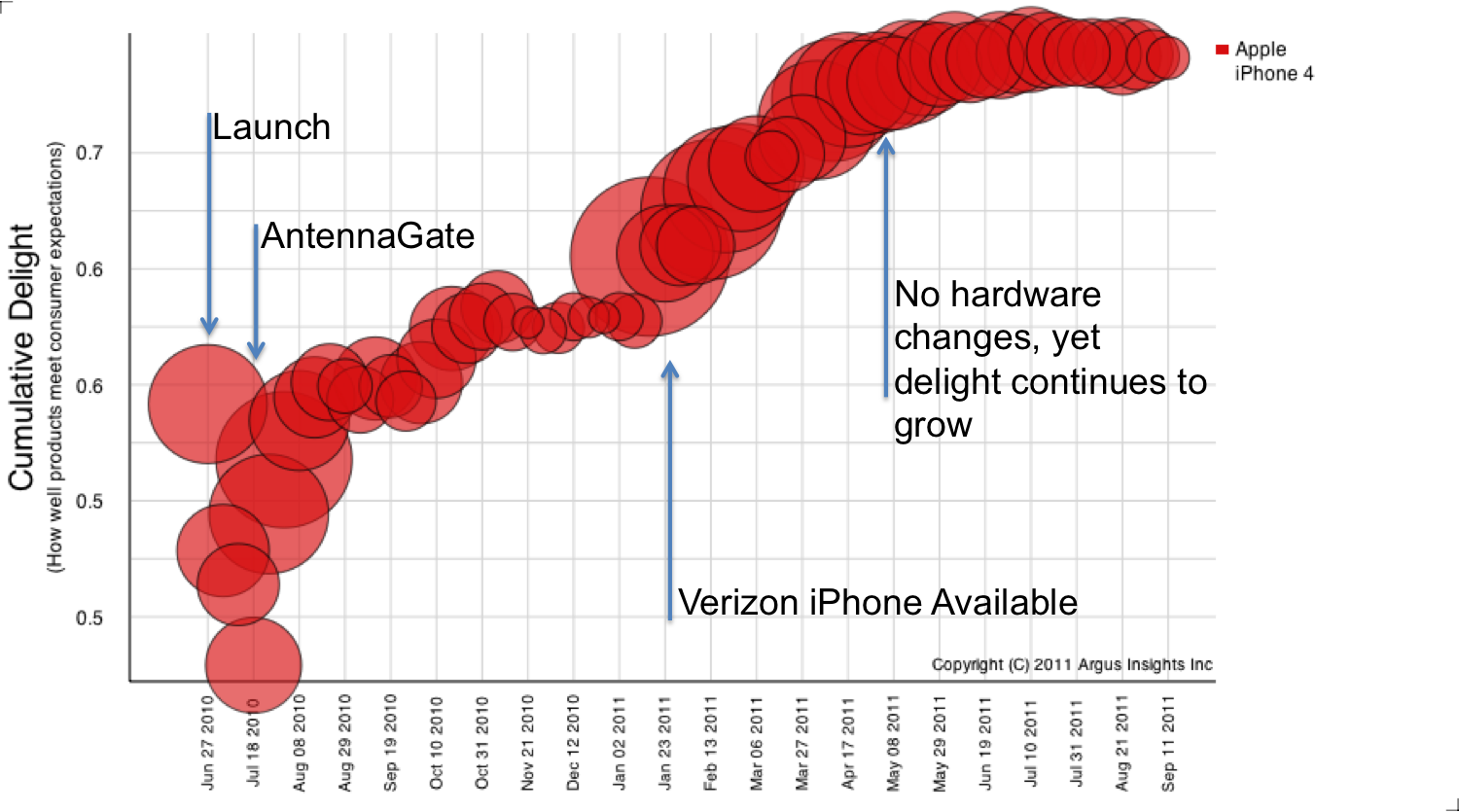
Why? Because carriers matter. Below you’ll a chart of the overall smartphone experience with the iPhone 4 represented as a separate measure of market expectations. The iPhone 4 had a surge this past winter as Verizon was able to open it’s doors to iPhone refugees. No changes in hardware, no major OS changes, simple a change in the network the phones had access to and voila, an 80% increase in the reported user experience over the AT&T baseline. Carriers matter, period.
Our graph of the Verizon Surge shows the average Cumulative Delight (on a scale of -1 to 1) for the smartphone market as measured from each product release date. Typically products decline in delight over time as new products are released and disrupt existing user experiences. This didn’t happen with the iPhone 4. This late in the game surge is due to the opening of Verizon’s network to iPhone 4 customers who were delighted to have a smartphone they could use to make phone calls.
But for the Sprint and Apple partnership will we see the same synergies manifest? We think so for the following reasons. iPhone 5 reflects the evolution in smartphone usage and tablet usage as well as the competitive
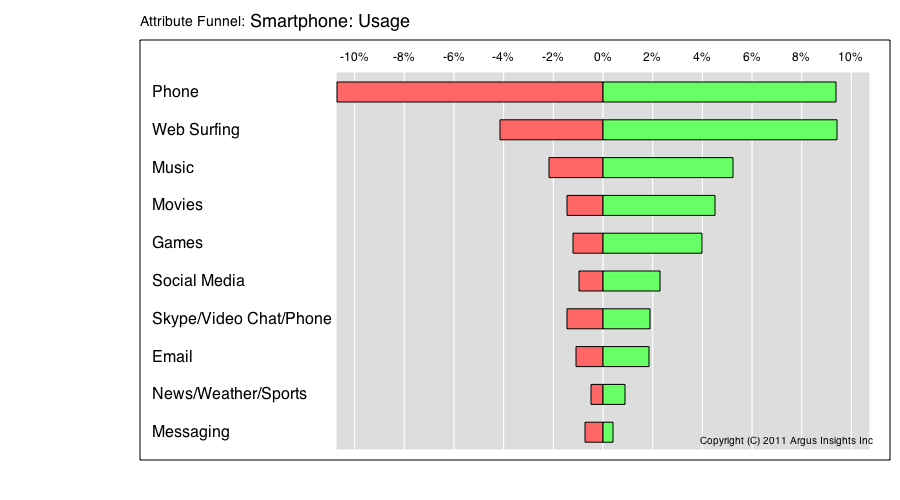
pressures from the likes of HTC, larger screen, faster processor, effectively becoming a mini-iPad that can make phone calls (because face it, it’s hard not to laugh when you hold your iPad up to your ear to answer that call from Mom). Larger screens hint towards an even greater focus on content consumption, surfing, gaming, movies, etc. the same trends we are seeing across both Tablet and Smartphones. See the graph below to see how the conversations about smartphone reflect usage levels. The green bars on the right show the distribution of positive comments across all reviews and the red bars on the right show the negative comments across all reviews. Notice that of the top ten most discussed usage scenarios, the remaining nine almost double that of using the phone as a phone.
We spend more time on our phones not talking as we spend talking. This deluge of content requires bandwidth and the US network with the most mature 4G (real 4G, not rebranded 3.5G) is Sprint. This means that Sprint is the best positioned network to help Apple deliver on the promise of the fully turbocharged iPhone 5 experience, especially as they become more reliant on cloud based delivery systems. Amazon’s recent announcement of the new Kindles, especially the Fire, coupled with the ambitious launch of the Amazon Silk browser puts additional pressure on Apple to get the extended parts of their growing content empire dialed in. Sprint could be the right partner to deliver on this promise to the broadest swath of the market. We look forward to watching this story play out over the coming weeks and months. Contact us if you would like more details on the impact of the iPhone 5 on the mobile competitive landscape.
You may have heard IDEO founder David Kelley talk about the importance of hiring T-shaped people. These are folks with a depth of expertise in one area, but enough breadth of empathy and skill to work across multiple domains. This organizational design insight is one of the keys to IDEO’s successful creation of multidisciplinary innovation teams that consistently turn out heart-stopping innovation after another. You could make the argument, quite successfully, that it takes teams of T-shaped people to create T-Shaped experiences.
What’s a T-shaped experience? It’s one in which the ecosystem creates a coherent and delightful flow through the arc of the experience for the user, but requires the coordination of several disparate ecosystem partners. The most notable experience of late is the device-content-service ecosystem that Apple has created around the iPhone. Apple has chained several players around the anchor of their device to architect one of the most defensive consumer positions in the market today. What’s interesting is how others are leveraging this same play using their own T-shaped anchor.
Amazon surprised the world when they went into the hardware business and launched the Kindle. Amazon leveraged their T shape with strong content and retail experience to extend into a dedicated and unprecedented reading experience. It’s the opposite tact of Apple, but just as effective in creating a powerful experience that Apple has had to compete with by changing their developer agreements when no other strategies proved successful. Barnes and Noble followed suit when they created the Nook. Both companies realized that people were not consuming less content (books, movies, music), but they were consuming it differently (no more CDs when you have Pandora, no reason to buy and carry 600+ pages of The Deathly Hallows when it can fit with the rest of your in-hand library). Rather than being left behind, Barnes and Noble chose to lead. Borders, unfortunately, realized this too late and didn’t follow their customers out of the store and into their homes fast enough.
But this is old hat! Why name these new experiences as T-shaped? It’s because this strategy is reshaping mobile computing. When Google announced intentions to buy Motorola’s mobile computing assets, much hype was made about the IP gains in defense of Android. Less discussed was how Google is embracing the T-shaped
experience by bringing hardware into their direct control. Google now could integrate vertically and horizontally just as well as Apple or Amazon. It also means that Motorola gave up in competing in a market place where their I-shaped experiences (hardware, hardware, and hardware) were not cutting the mustard with consumers. HP, in the face of difficult competition in a growing population of T-shaped experiences, decided to exit the market entirely rather than explore content parters to grow the right wings on their I. Now there are rumors of Amazon releasing a tablet, which will further extend their reach into the lives of their consumers and grow their wingspan at the same time. Question is, what is the next frontier?
We think it’s bandwidth—mobile broadband. Why? Because our thirst for content on these portable gateways into our connected lives makes access to bandwidth the weakest link in the experience. Witness in the graph below the rise in Delight by iPhone 4 customers when they could actually make a phone call on the Verizon network. AT&T was that awkward friend who came along for the road trip because it was their car. Once Apple proved they were cool enough to hang uptown, they were able to trade up for a friend with a beamer. Now the iPhone 4 is a complete experience. It’s a smartphone that can actually make phone calls!
This means that access to quality broadband service is a critical part of the next evolution of T-shaped experiences. Will we see Amazon buy Sprint to spread their wings further? Will AT&T purchase HP’s ailing assets and make a go of it? What will the dominate hardware manufacturers, like Samsung, LG, or Acer, do in the face of these market changes? Spread their wings or exit stage right? WWBGD? (What would Bill Gates Do?) These are questions to be explored in another post…
The world is moving rapidly to T-shaped experiences, because they are more defensible. Consumers enjoy the high-quality user experiences within these maturing ecosystems, but it brings with it significant disruption to the consumer electronics ecosystem—the impact of which we have yet to fully experience.