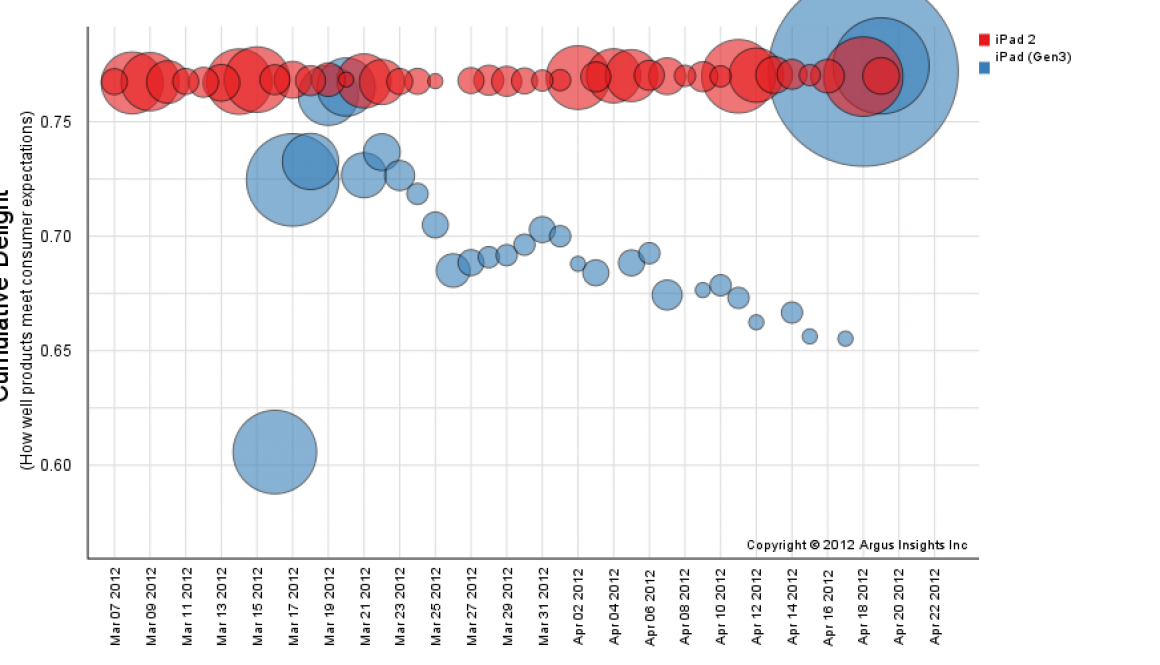
You know we’ve been sharing that the new iPad has proved to be a more compelling reason for consumers to buy an iPad 2 than the new iPad. Then the improbable happened. The iPad 3 recovered. It did more than recover, it jumped to the top of the charts. It’s like the whole family answered the call to review Aunt Bertha’s steamy romance model on Amazon when sales were flagging. Check out the graph below to see what we’re talking about.
The new iPad has a miraculous recovery in the hearts of consumers after tax day.
What happened? Was this the result of post Tax Day ex
uberance? “Now that I’m getting a tax refund, I’m buying a new iPad!” The new iPad jumped ahead of the iPad 2 after a rapid decline in delight, something unheard of for an Apple product. In fact, the new iPad is considered to be the most delightful tablet on the market today, barring any new releases in the coming weeks as you can see in the sparklines below.
Summary of top tablets in North America. The new iPad shot to the top after languishing in the middle for weeks after launch.
If you want to know why this drastic shift took place, give us a shout at Argus Insights. We’ll be releasing a report on all the sordid details of the new iPad’s market response in the coming weeks that will include our own forecast as to the future success of the new iPad.
Argus Insights CEO and founder, John Feland, is hosting a free webinar on Thursday September 29 at 10 A.M. PST. The webinar “Delight or Die. Does Your Product Only Satisfy?” will review a recent case from the tablet product category and dive into the key attributes that are important to tablet users. See how consumer expectations are shifting as new products are released and how consumer expectations change in response.
Feland will introduce you to Consumer Innovation Analytics (CIA) and show you, in real time, what consumers are expecting by product category. We are excited to show you how CIA can dete
ct market disruptions, measure campaign effectiveness, and plan for next-gen products or even quick-turn firmware updates. We’re getting one step closer to better experiences and greater market impact!
The market has voted. Consumers recommend not touching the TouchPad with a ten foot pole. The Touchpad has had the fastest decline in delight we’ve seen, ever, in the Tablet market. Within two weeks of launch, it went from being one of the highest rated experiences in the market to one of the lowest.
The question is “why?”. There are all sorts of pundits talking about their high hopes for the TouchPad experience, especially as a potential ecosystem alternative to the iPad. Based on what we’re seeing in our data from actual users, HP failed to execute on the basics. Across the board, the top usage scenario for Tablets is content consumption, typically in the order of Web Surfing, Movies, Games, Books, and Music. Here’s how the TouchPad usage stacks up:
Notice that on the features that matter most, users, even those that love the TouchPad, are not hot on it’s ability to support content consumption. What’s even more telling is where enterprise usage ranked. The TouchPad was supposed to be THE tablet for the busy professional, providing rock solid enterprise support. Professional usage, “Work” ranked 9th of overall usage topics mentioned with a net negative sentiment across the board. This means the TouchPad not only didn’t measure up the expectations of the core Tablet market, but also missed the mark for the core niche they were aimed on delighting.
Luckily HP has an advantage over their competition–Web OS. Overall, the OS was a source of delight for consumers, though the lack of Apps within the WebOS ecosystem continues to be an issue. If they leverage the over-the-air capabilities they pioneered with the Palm Pre, then disgruntled users may find an improved experience.
Let’s just put it out there. How is HP’s TouchPad going to rise above the rest in this maelstrom tablet market? If you look at the different strategies available to HP, the choices are few. They could take a page out of RIM’s Playbook and tightly couple the TouchPad to WebOS phones, but this limits their appeal to loyal Palm customers, an unfortunately shrinking population. The other potential is to pull from Apple’s fruit basket and provide an experience so compelling that people will be drawn into the WebOS ecosystem. After all, this is how Apple won hearts and minds with the iPod. People actually purchased Macs based on their iPod experience.
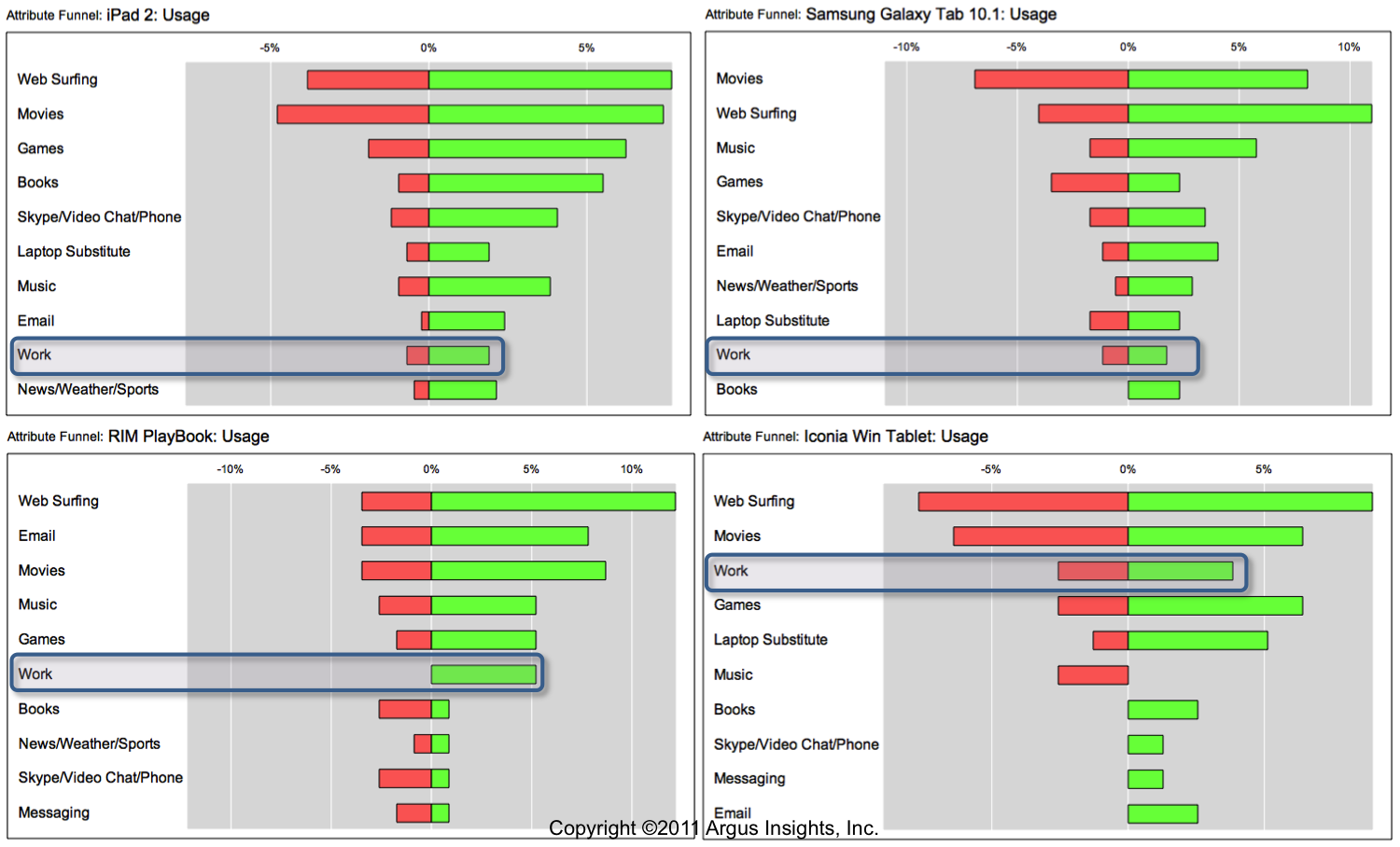
So how can HP use the TouchPad as a gateway drug into the WebOS ecosystem? Phil McKinney has been touting that the TouchPad will be transformative for the enterprise. Based on our data here at Argus Insights, they may have a chance. As people discuss their tablet usage, only the Playbook and the occasional Windows 7 Tablets evoke notions of “professional” use. Notice below how the topic of “work” compares across usage modes for tablet users.
case with games mentioned above professional usage. Tablets mimic our smartphones more than our laptops from that point of view. The need for an Angry Birds fix has extended to larger Tablet screens. As such the TouchPad has to enable users to work hard and play harder!
The Surfing Experience must mimic the laptop, not the smartphone
iPad users continue to lambast Apple for the lack of Flash support on the iOS browser. (Trust me, we have the evidence. Just ask!) Given the larger screen of tablets, user expectations are shaped by their laptop usage more than their smartphone. One of the key marketing features being touted by Android tablets is their Flash support. Tablet users expect that browsing the web on a tablet should look like, well, the web, not some gossamer threads of the web viewed through the peephole of the smartphone screen.
Plan for multiple users. Tablet’s aren’t personal
Unlike laptops and smartphones, tablets are increasingly becoming group computing devices. “Hey dear, toss me the iPad. I want to look something up real fast.” “Mom, can Candice and I play Angry Birds on your Iconia?” HP has the opportunity to add personas to the TouchPad so that the device tailors its experience to the user who happens to hold it. This could be a huge source of delight for families if they also improve the stickiness of the WebOS experience as HP seeks to win over consumers.
The TouchPad will determine if HP + Palm > Apple. We all are watching with baited breath to see if the TouchPad shows up in our homes or on Woot.com.*
*At Argus Insights we view Woot.com and other deal-a-day sites to indicate whether or not a particular device has “Jumped the shark.” Argus Insights does not endorse any third-party products or services.
We recently did a post on the rapid consumerization of the enterprise, starting by looking how the semiconductor industry traded the boom and bust cycles of the enterprise market in for the more “consistent” cycles of the consumer market. Now we are seeing consumer grade tech invade the enterprise like a locust swarm. This latest revolution has been driven by Apple and the iPhone. While Blackberries remain the badge of “serious” business, the iPhone rapidly was snatched up by CEO and janitors alike, rapidly becoming the badge of “cool” business. The sprouting of hundreds of walled gardens of Apples inside the corporate firewall has driven CIO’s sleepless and insane as they struggle to maintain the paradoxical duality of Sarbanes-Oxley mandated information access & control paradigm cohabitation with the “let’s mix our sales forecast numbers with Angry Birds high scores” world of iPhone and Android devices.
We’ve seen Apple and Google both make concessions for the enterprise customers attempting to extend the consumer lifestyles into the “business formal” parts of their day. But this was smartphones, devices that worked mainly as conduits to colleagues through voice and email. Occasionally users would attempt to review and mark up documents on the tiny screen. Once finished this lilliputian task, these users would immediately dial-up their optometrist to be treated for eye strain.
Tablets, yes tablets, are a different matter entirely. Now you have a comparatively larger screen that grants the magic ability to do more than passively consumer content. Tablet users can now actively engage with these devices for the critique and creation of content. Those CIO’s that survived the first wave of consumer smartphones washing over their SOX levies and now looking at the rising flood waters of tablet use and hitting the speed dial for their therapists. When will these waters of tablet use
in the enterprise overflow the carefully built dykes of security anytime soon?
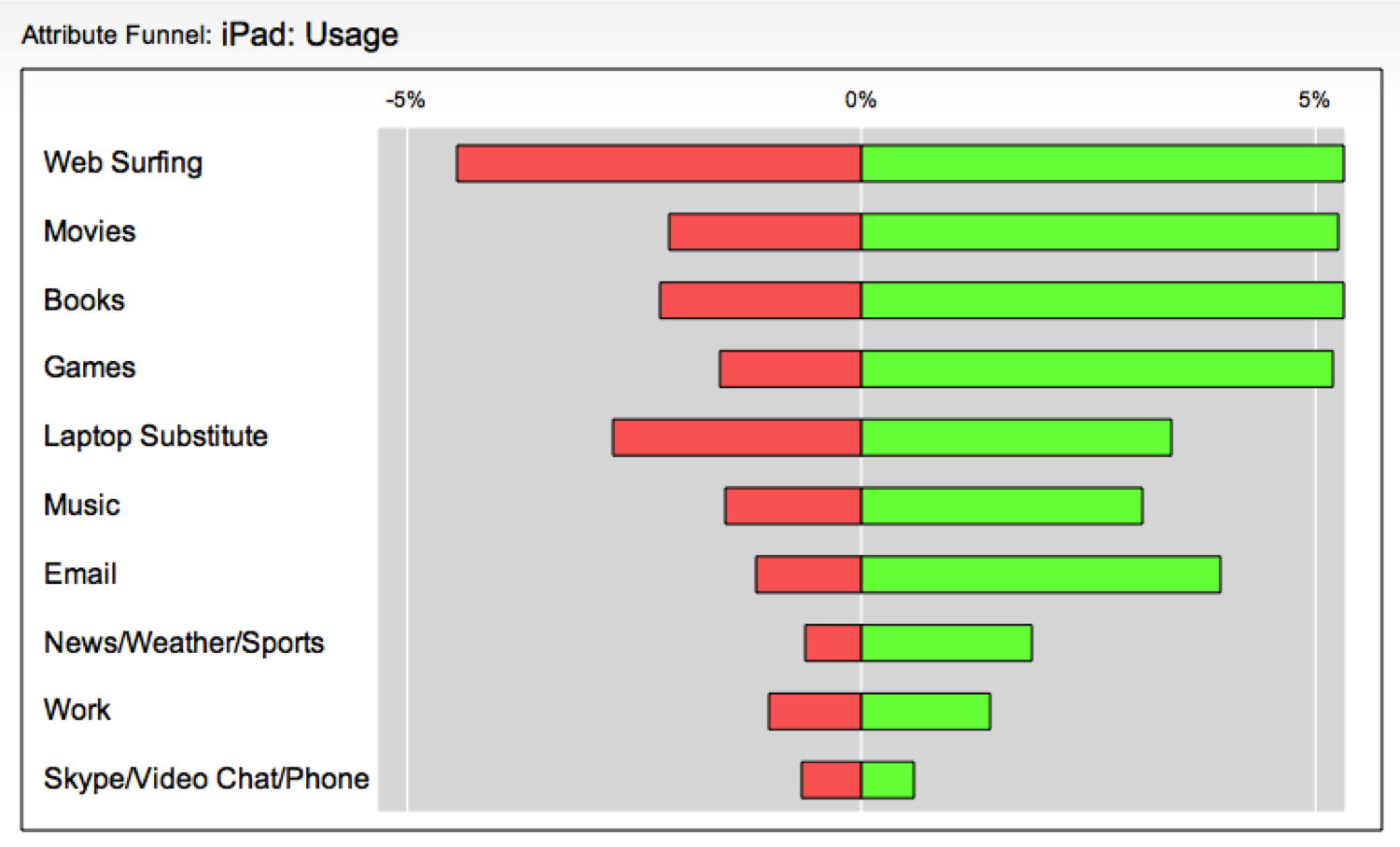
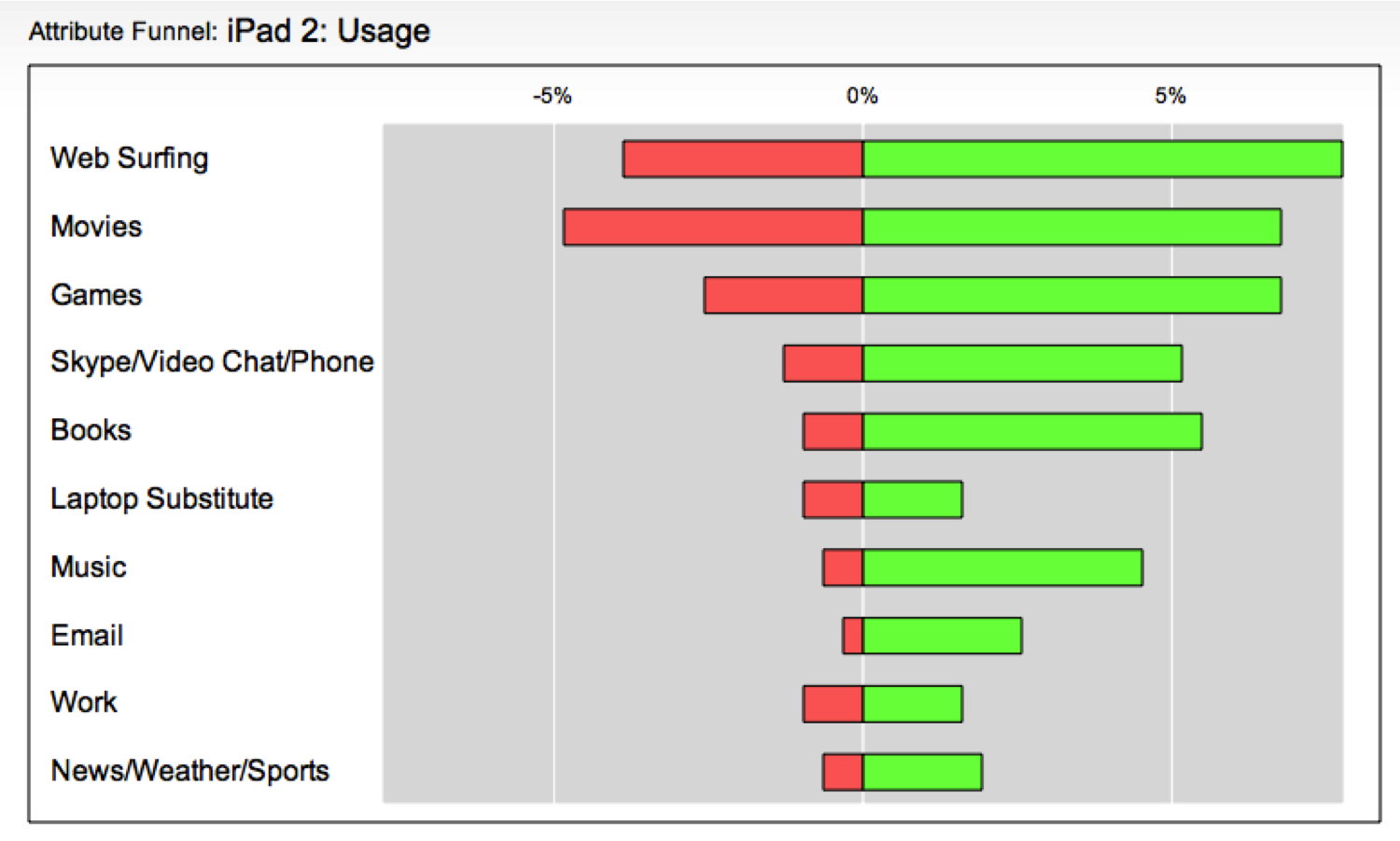
Yes they will. Our information on tablet usage is showing an increasing number of iPad and iPad 2 users are leveraging these constantly connected windows of wonder for their day jobs. As you can see in the Attribute Funnels below for the iPad and iPad2, “work” ranks as the 9th most common activity users mention as they share their experiences with others. What’s interesting is that, even between product generations, roughly 5% of all iPad/iPad2 users are utilizing it for some sort of professional use.
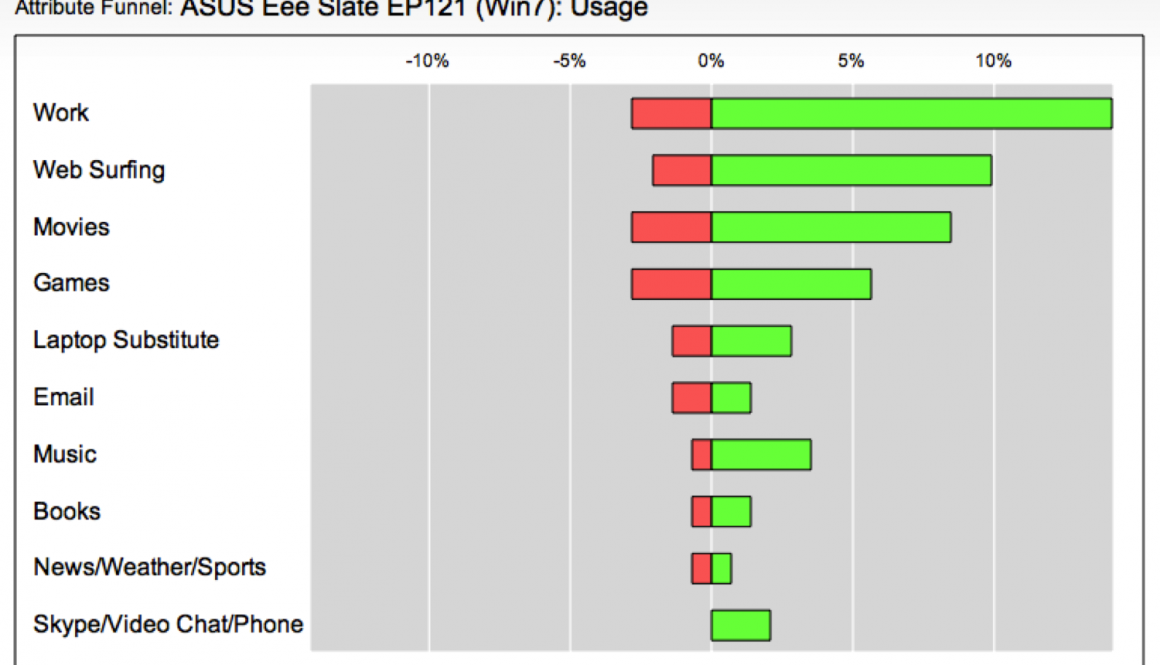
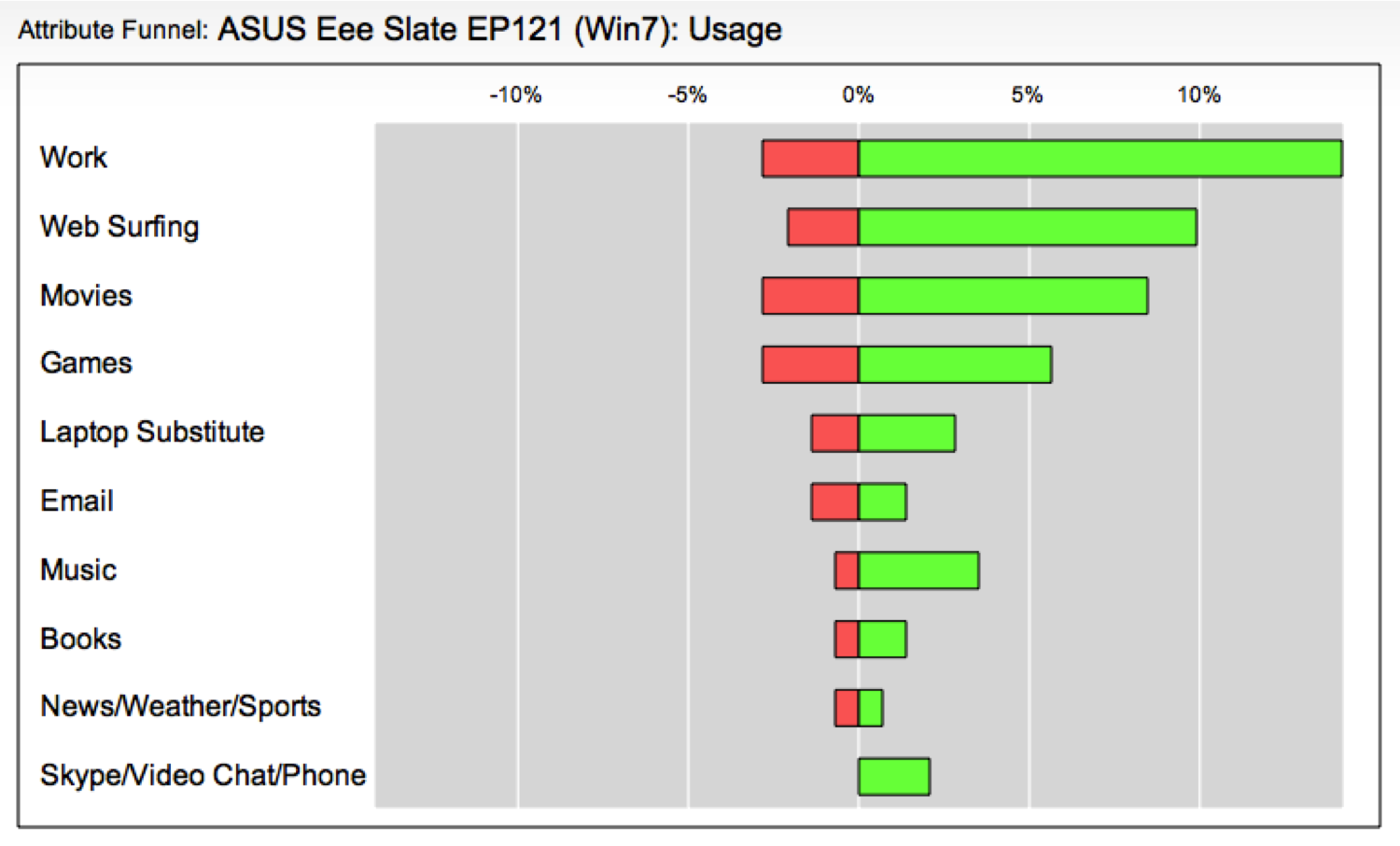
Now contrast this with the ASUS Eee Slate. Users of this trim little Windows 7 device rank professional activity as their top usage, with over 12% of users making mention specifically of work activities. Remember our nervous CIO’s from above? They love the Eee Slate. It’s an OS they already support, able to run applications they already have control over. This is a product that fits needly into the existing corporate ecosystem and this message comes across from the users.
So the question on the table is, given the increasing availability of enterprise/CIO friendly tablets, with the nose of the iPad’s eventually make it all the way into the tent of the modern enterprise or will employees be increasingly asked to leave their toys at home.