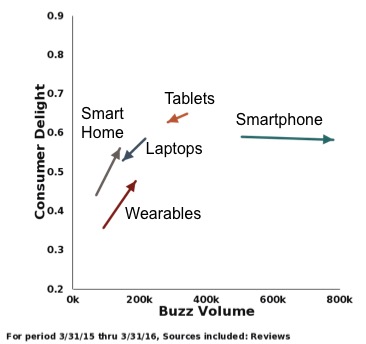
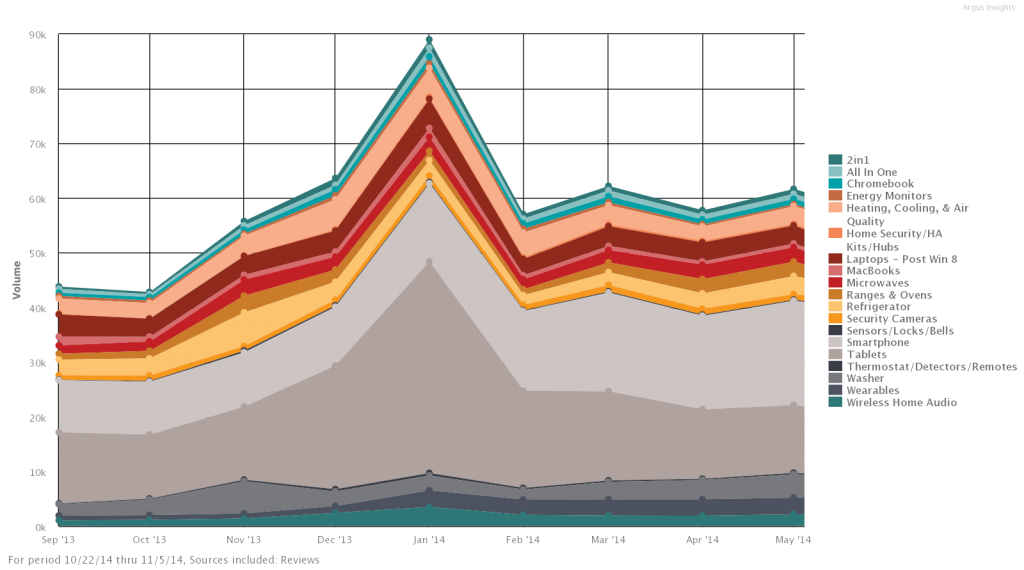
Smart Home has significant growth opportunities in 2016. While consumers are losing interest in Tablets and Laptops, which saw big drops in both buzz and delight from March 2015- March 2016, Smart Home and Wearables are maturing both in user experience and demand. Though Smartphone buzz increased, the market saw growth slow significantly in recent months, with users expressing less satisfaction.
Chart of the Day: Wearables and Smart Home on the path to growth
Discover what is top of mind for consumers in these growing markets on a regular basis by signing up to receive our free newsletters.
Find Out Which Brands and Products were the Biggest Winners in Barcelona
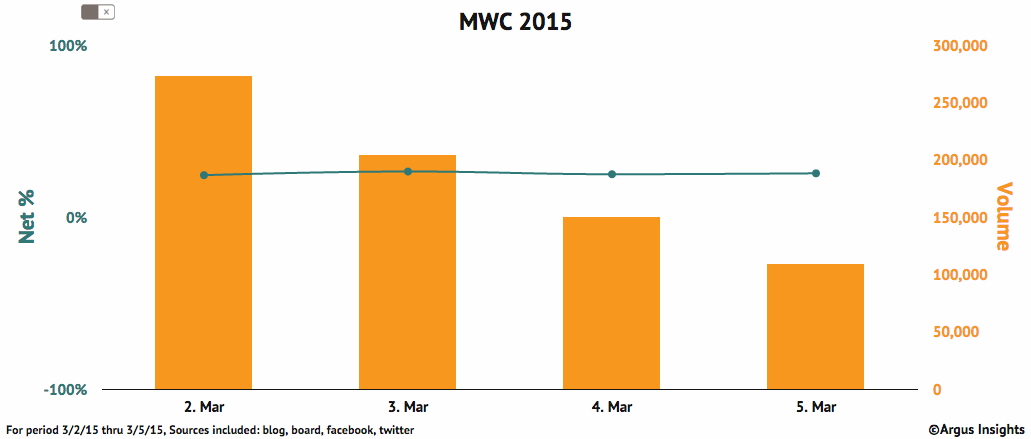
Argus Insights has been monitoring social conversations at this year’s Mobile World Congress in Barcelona. Before MWC, we hosted a webinar highlighting the brands and products that drove the most mindshare heading into the showcase, for which the slides and presentation are now available to download. Simply fill out the form and we’ll send that your way immediately.
Now that the event has passed, find out which brands, products, and tech trends were sparking interest during MWC. Argus Insights would also like to offer a free Post MWC 2015 Report (usually valued at $3,000) as a gift. The stories that we are finding are just too good that we believe everyone can benefit from the data. The world is talking and we’re listening, take advantage of our comprehensive analysis:
Discover what topics are most important to consumers
Examine market trends and consumer preferences
Gain actionable insight
If you want to stay up to date with trending social content, sign up for our weekly newsletters in the Smartphone, Wearable, Home Automation, and SDN/NFV markets. Leverage Argus data to gain an upper hand in the marketplace.
The Black Friday advertising has already started to hit consumers in full force. Every year for the past few decades, retailers have ratcheted up the deals and steals used to temp consumers to shake off their post Thanksgiving food comas and shuffle like the walking dead to their retail outlets in the twilight of the early morning hours before any self respecting rooster would consider it polite to greet the rising sun. The sequel to this mass retail migration to participate in the largest mixed martial arts contest with your fellow holiday cheer bringer is the equally frenzied Cyber Monday sales during which Amazon’s bandwidth and electricity consumption for a single 24 hour period could power all of Latin America for a year. Are the millions spent by retailers to extract billions from our pockets in these magical 8 days each year focused on the right products? Is that laptop priced at $150 really worth knee surgery you’ll have to schedule after the holidays due to injuries sustained while clawing it from the hands of that nice grandmother that lives down your street? Is a new myPad you got for under $300 really going to drive smiles come January?
Argus Insights separates the hype from the reality in our first annual Black Friday Hit Parade webinar. Pulling on the insights gathered from the most important voices in retail, consumers themselves. Argus Insights CEO, Dr. John Feland, will walk through the hottest products on the market today. Based not on what the brands are promising or the pundits are selling, but on what is delighting consumers. See if the new iPhones are all that, what is the best tablet for hard fought recession dollars, whether Chromebooks really replace laptops for consumers, and more. With data on over 7,000 products across over 400 brands, Argus Insights will identify likely winners of the holiday shopping frenzy and uncover hidden gems that are better candidates for the top of holiday wish lists than the dominant brands.
Why pay attention to Argus Insights? Our metrics of consumer adoption have embarrassed Wall Street estimates of iPhone sales almost every quarter for the last three years. While others track the hottest brands, we measure what consumers decide are the hottest experiences, a proven predictor of market success.
Get insightful with Argus on November 17, 2014 and join via webinar us as we cover a variety of popular product segments that consumers camp out for: 2-in-1s, laptops, tablets, wearables, smartphones and appliances.
I don’t know about you but my inbox has been awash with ads from Apple and others with first class tickets for a guilt trip if I don’t get my mom (or my wife) an iPaxly Fire tablet or Next S5 Dash 8 smartphone for Mother’s Day next weekend. The gadget blogs have all been discussing what is the best phablet to get for the mom that desperately needs more megapixels in their live and delivers more cores than Octomom! But this is for Mom. Do we want to trust the guidance for a gift to the person that brought us into this world to the manufacturers who seek to siphon off more of mom’s monthly income in the name of ARPU so that you’ll have to support her later in life? No! Do we listen intently to the same geeks that told us the iPhone was a toy and that vinyl was dead? No! We listen to the one that soothed our sore throats with love and honey, that kissed our skinned knees, that ensured us there are plenty of fish in the sea if we were patient. Mom, or in the case of Argus Insights, other moms.
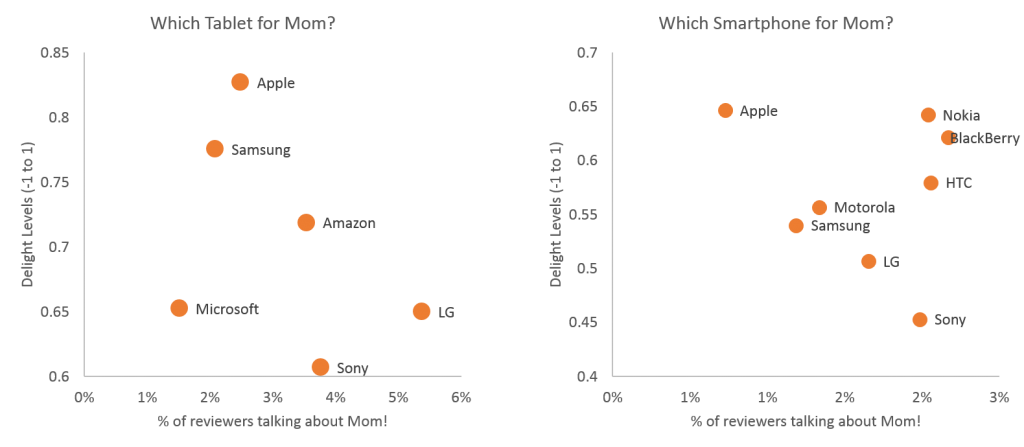
We culled through the millions of mentions by tablet and smartphone owners to see for those that discussed mom, and determine which brands delivered an experience worthy of our maternal gratitude.
Within tablets there is little surprise that Apple comes out on top. What is surprising is that more iPad owners aren’t chatting about the awesome gift they got mom. Amazon hits the sweet spot for the balance between price and delight while, juggernaut Samsung lags just behind Apple. Across the board, those reviews that mention Mom were higher rated than the rest of the population, bolstering the notion that Mother Knows Best.
Smartphones tell a different story though with the same beginning with Apple still leading the pack, just barely but with the lowest mom mentions of all the brands. Moms tell us that they like Nokia Lumia handsets just as much as iPhones (Mom always did like a bargain). Oddly Samsung is beat out by Nokia, HTC, even BlackBerry, whose recent push on Enterprise Mobility might need to shift to Enterprise Moms instead!
While this has all been a bit tongue in cheek (because Mom taught me not to stick out my tongue), the results are based on actual consumers discussions of what tablets and smartphones they love. The same data we used to beat Wall Street on Apple last week is being used to help you think about what to get Mom this year. So do Mom a favor, get something that will make life easier rather than forcing more gigabytes down her proverbial throat the way she forced you to consumer castor oil as a child.
Think about your best customer service experience…
Was it selecting a nice wine at an elite restaurant? Taking wind surfing lessons at a Caribbean resort? Picking up milk at the grocery store? What resonated about that experience? What made it stand out? Who did you tell about it?
The distance between delight and disappointment narrows as it becomes easier for consumers to share experiences in social media. It’s no surprise that people like to be treated well.
It’s an often-reported fact that lipstick sales rise during times of economic challenge because it is seen as a small way for consumers to treat themselves. If people are willing to forego scarce resources to add a little delight to their lives, why is there not a customer service arms race happening across retail markets? Why, in the face of shrinking margins and fierce competition, are consumer product and service companies not falling over themselves to provide you with a “lipstick” experience?
I believe it’s because it’s easier to measure the cost savings of cutting features and personnel than it is to measure the ROI from delivering a delightful ecosystem experience to the marketplace. Apple’s success over the past several years has proven that delight sells. The market has spoken, and loudly. Each product and service within the ecosystem serves as ambassador to the greater portfolio. For many, the iPod was that free weekend at the timeshare that sold the market on fractional ownership in
Other companies seeking to compete either miss the ecosystem story or execute it poorly. For example, RIM’s strategy to make the Playbook part of the Blackberry ecosystem requires a tethered Blackberry for access outside of Wi-Fi. It forces handset use for email on the larger screen and fails to let outsiders play. The experience without the handset does not merit a non-RIM customer to sample the experience.
Most Android competitors fall into this “lack of ecosystem” category. Their tablet as just another piece of hardware running an OS they don’t control. It’s not their fault per se. Laptop OEM’s are out of practice. Their recent experience is that customer loyalty is based on speeds and feeds, manufacturing quality, and industrial design. The intangibles of the experience birthed from the hardware/software experience tend to be owned by the OS provided, Microsoft or Google. Given the lack of industrial design potential behind a flat piece of glass wrapped with a battery, motherboard, and plastic, there is little left in their usual bag of tricks to differentiate the tablet experience.
This leaves most companies in the conundrum of betting the farm on new and unpredictable delightful experiences or bleeding to death by optimizing to metrics that obviously don’t drive success. Argus Insights’ measures of Experience Equity allow decision makers to tie the experience innovation to future revenue. We can answer questions such as:
Which product attributes matter the most to my customer?
Which experiences allow my competition to win?
Why are these experiences winning or losing?
With this level of sentiment data now available on demand, go ahead; treat your customers to the experience they deserve…and grab the mindshare you deserve.